
November 11, 2026
Scalp Oil Applicators: Reading Claims and Evidence
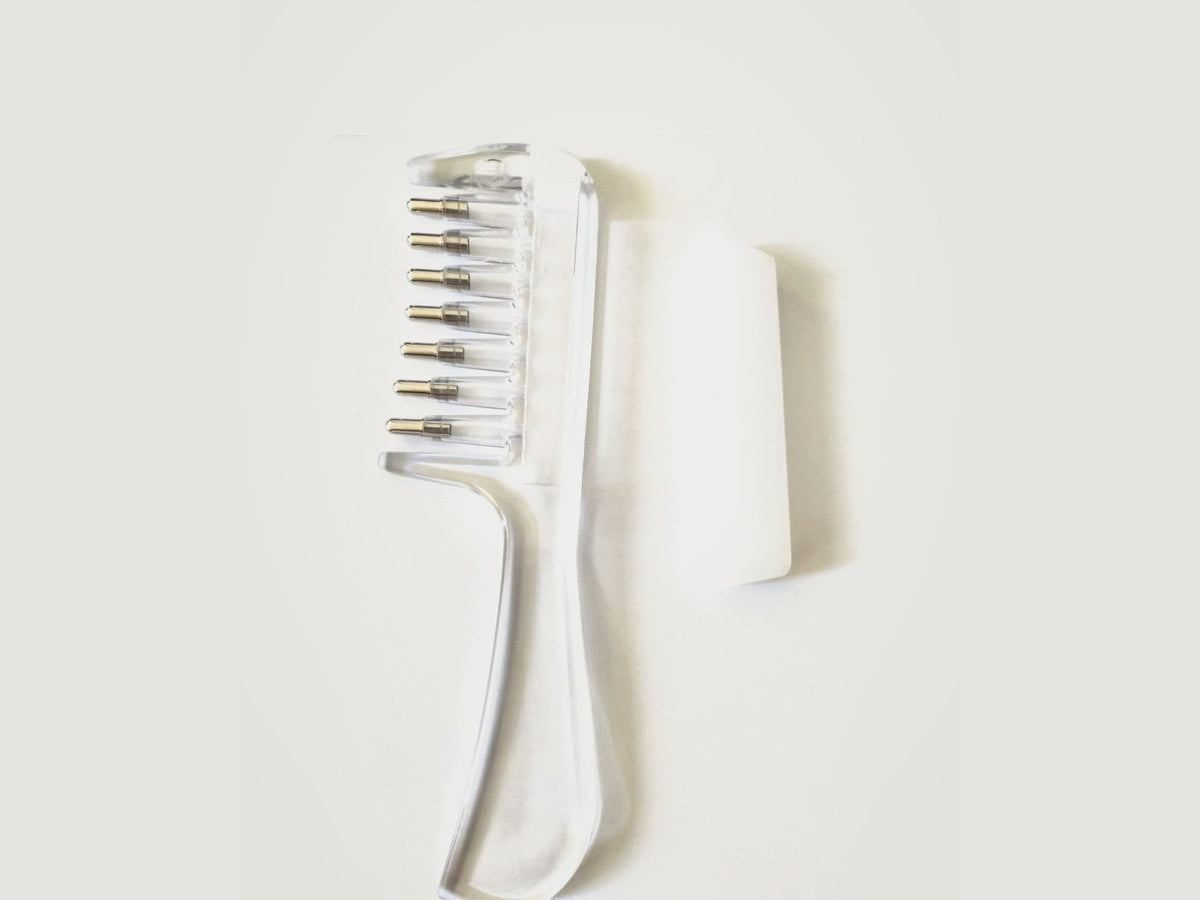
Short answer: NIB COMB is a tool for placing oil along a part line. This guide makes no claim that it, or any oil you put in it, changes hair growth, hair loss or the scalp. Claims like that need strong evidence, and none is presented here. That restraint is also a useful lens for reading any listing in this category.
What this guide says, and what it does not
| This guide describes | This guide does not claim |
|---|---|
| A clear, empty applicator with a reservoir of about 4 ml | That any amount of oil is right for your scalp |
| Exactly seven metal tips | Hair growth, thickening, or reduced hair loss |
| A silicone cap and a dropper in the box | Any treatment of a scalp or hair condition |
| Where the tool is designed to place oil: along the part line | Before-and-after results |
Why the line falls there
Claims define what a product is
In the United States, whether something is regulated as a cosmetic or a drug depends on its intended use, and the FDA explains that intended use can be established by "claims stated on the product labeling, in advertising, on the Internet, or in other promotional materials." Its own list of claims that can make a product a drug includes claims that a product "will restore hair growth." Words are not decoration in this category. They change what is being sold.
Health claims need serious evidence
The Federal Trade Commission's Health Products Compliance Guidance says health-related claims must be backed by "competent and reliable scientific evidence", and that, as a general matter, this will need to be randomized, controlled human clinical testing. No evidence of that kind is presented in this guide, so it makes no outcome claims.
The tool is not the treatment
Even if a particular oil had well-supported effects, those effects would belong to the oil, not to the comb that placed it. When an applicator listing leans on an ingredient's reputation, it is worth asking what the tool itself is claimed to do.
Reading other listings through the same lens
A few questions turn this into a practical filter:
- Is the claim about the tool or about the body? "Holds about 4 ml" describes the tool. "Regrows hair" describes the body, and needs far stronger support.
- Is a well-known ingredient doing the talking? If a tool listing leans on what an oil supposedly does, ask what the tool itself is claimed to do.
- Is there a before-and-after photo? A pair of photos cannot show what caused a change, how typical it is, or whether the conditions matched.
- Is "clinically" attached to anything specific? If a listing says a product is clinically proven, look for what was tested, on what, and by whom. Vague answers are an answer.
What this means for you as a buyer
This guide promises no result. It describes an object, what is in the box and where to find the current policies. If you are oiling your scalp for a particular reason, the evidence about that belongs with the product you choose and the professional you consult, not with the applicator.
Some people want exactly that: a tool that does its narrow job and leaves the rest of the routine to them. If that is you, the NIB COMB product page describes the comb, what is in the box and the current sets.
No. 005 · Catalogue note. Fig. 01, the cover photograph, shows the comb empty, as it ships. NIB COMB is sold empty: a clear applicator holding about 4 ml, with exactly seven metal tips, a silicone cap and a dropper. Oil not included. Single $17.99 · Pair $29.99 · Trio $39.99 USD, with free worldwide shipping, 4–8 business days. Orders arrive in 4–8 business days, including 2 business days to prepare your shipment. Unopened combs can be returned free within 30 days of delivery; see the refund policy.